Mild sensitivity for a few days to a couple of weeks after a new crown or filling is common and usually fades. Pain when biting that doesn't improve, pain that lingers after hot or cold, or throbbing on its own are signs to call the dentist. Often the fix is simple, like adjusting the bite.
What's normal
- Sensitivity to cold air or cold drinks for a few days
- Gum soreness around a new crown, where the gum was handled
- A slightly "different" feel to your bite for a day or two
- Mild tenderness that steadily improves
What's not normal
- Pain every time you bite down
- Sensitivity that gets worse, not better
- Lingering pain after hot or cold
- Throbbing that wakes you up
- Swelling in the gum or face
Common reasons it hurts
The bite is too high. If the new crown or filling touches first when you close, that tooth takes extra force. It often feels bruised. A quick adjustment usually fixes it.
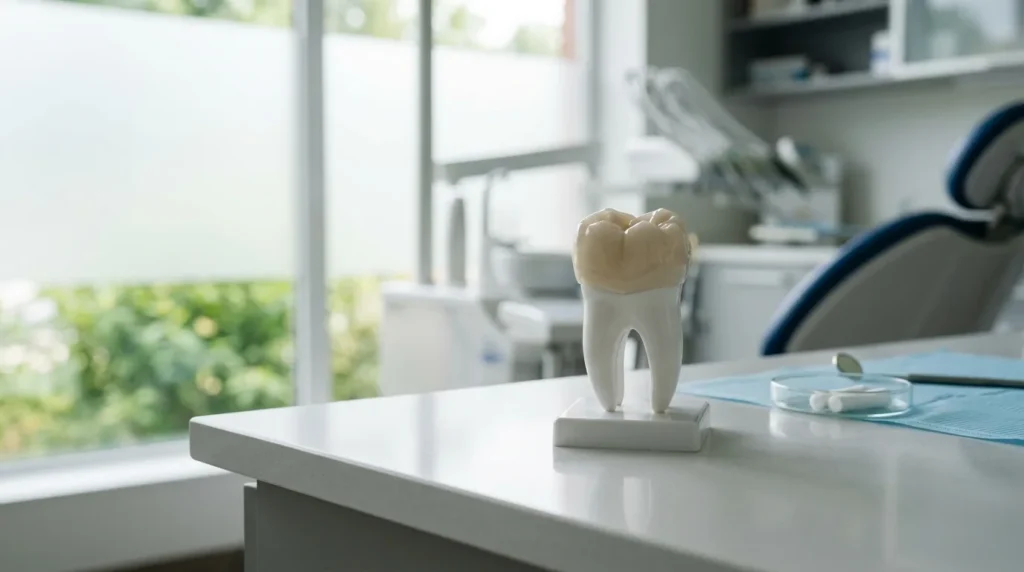
The nerve is irritated. Deep decay or a lot of work near the nerve can leave it inflamed. Mild cases settle with time. Sometimes the nerve doesn't recover and needs root canal treatment.
A gap at the edge. If food or bacteria get under the edge of the new work, the tooth can stay sensitive.
A crack. A tooth that needed a crown may already have had a crack that still causes pain.
Gum irritation. Cement or tissue swelling around a new crown can make the gum sore for a few days.
How long to wait
| Symptom | When to call |
|---|---|
| Mild cold sensitivity, improving | Give it two to four weeks |
| Pain on biting | Within a few days |
| Lingering pain with hot or cold | Within a few days |
| Throbbing or swelling | Same day |
What helps meanwhile
- Use a toothpaste for sensitive teeth.
- Avoid very cold or hot foods on that side.
- Chew on the other side if biting hurts.
- Use an over-the-counter pain reliever as directed if needed.
Rarely, a tooth flares into an infection after dental work. Swelling that spreads beyond the gum toward the eye or neck, or any trouble breathing or swallowing, means going to the ER. More guidance is on the American Dental Association's emergency page.
What the dentist will do
The dentist checks your bite with marking paper, tests the tooth and may take an X-ray. Fixes range from smoothing a high spot to treating the nerve. More on our filling and crown page.
Learn more from health organizations
These sources were used as background for this article:
- American Dental Association: Crowns: what crowns do and how they are placed
- Mayo Clinic: Sensitive teeth: causes and treatments
Need an Emergency Dentist?
Fill out the form and we'll call you as soon as possible to set up your visit.
Prefer to talk now? Call (323) 433-6458
If you have trouble breathing or swallowing, or swelling that is spreading, go to the emergency room or call 911.
Frequently asked questions
Is it normal for a crown to hurt weeks later?
Mild sensitivity can last a few weeks. Pain on biting or lingering pain should be checked.
Can a high bite really cause that much pain?
Yes. Even a tiny high spot can make a tooth very sore over a few days.
Will I need a root canal?
Not usually. Most post-treatment sensitivity settles. If the nerve doesn't recover, it may be needed.
If you're in Reseda
Our office on Saticoy Street is open Monday and Wednesday, 9:00 AM to 6:00 PM, Tuesday and Thursday, 10:00 AM to 7:00 PM, and Friday, 8:00 AM to 5:00 PM. Call (323) 433-6458 for a same-day visit. After hours, an answering service takes your call. For patients paying without insurance, the emergency exam and diagnostic X-rays are $99.
The $99 covers the emergency exam and diagnostic X-rays. Treatment is priced separately and explained before any work begins.
For payment options, see our cost page.
This article is for general education and is not a substitute for an exam by a licensed dentist.